By Rupesh Kumar
Published: September 21, 2025
Last Updated: February 18, 2026
Introduction
ETF vs Mutual Fund — this was something I didn’t understand when I started investing in 2018. At that time, I only knew about mutual funds. Every advertisement said, “Mutual fund investments are subject to market risks,” and I assumed mutual funds were the only safe way to enter the stock market.
A few months later, a friend told me about ETFs. He said, “It’s like a mutual fund, but cheaper.” That confused me. If mutual funds already exist, why do ETFs exist?
So I did what most beginners do — I tried both.
In the beginning, I didn’t fully understand how ETFs worked. I even bought one at the wrong time and saw it fall. But slowly, after reading and investing for a few years, things became clear.
Now in 2026, ETF investing for beginners in India is becoming common, but many people still ask the same question:
ETF vs Mutual Fund — which is better ?
Let’s start from the basics.
What Is an ETF (Exchange Traded Fund) ?
An ETF (Exchange Traded Fund) is a basket of shares that you can buy and sell on the stock exchange, just like a normal stock.
If you’re wondering what is an ETF fund in simple terms, think of it like a thali. Instead of buying only one item, you get a mix of many items together.
For example, a Nifty 50 ETF contains shares of India’s top 50 companies. When you buy one unit, you indirectly invest in all those companies.
That’s why ETFs are often called index-based investing.
In India, ETFs usually track:
- Nifty 50
- Sensex
- Bank Nifty
- Gold
- International indices
This is why exchange traded fund India investments are growing quickly — they are simple and low-cost.
Understanding this makes the ETF vs Mutual Fund concept much easier.
The biggest advantage I noticed when learning ETF vs Mutual Fund was the low cost of ETFs compared to many mutual funds.
What is Mutual Fund ?

A mutual fund is also a basket of investments, but it is managed by a professional fund manager.
When you invest in a mutual fund, your money is combined with thousands of other investors. The fund manager decides which stocks or bonds to buy.
This makes mutual funds very beginner-friendly.
When I started investing, mutual funds felt easier because:
- SIP was automatic
- I didn’t need a Demat account
- I didn’t need to track markets daily
That’s why many beginners start here.
etf vs mutual fund which is better

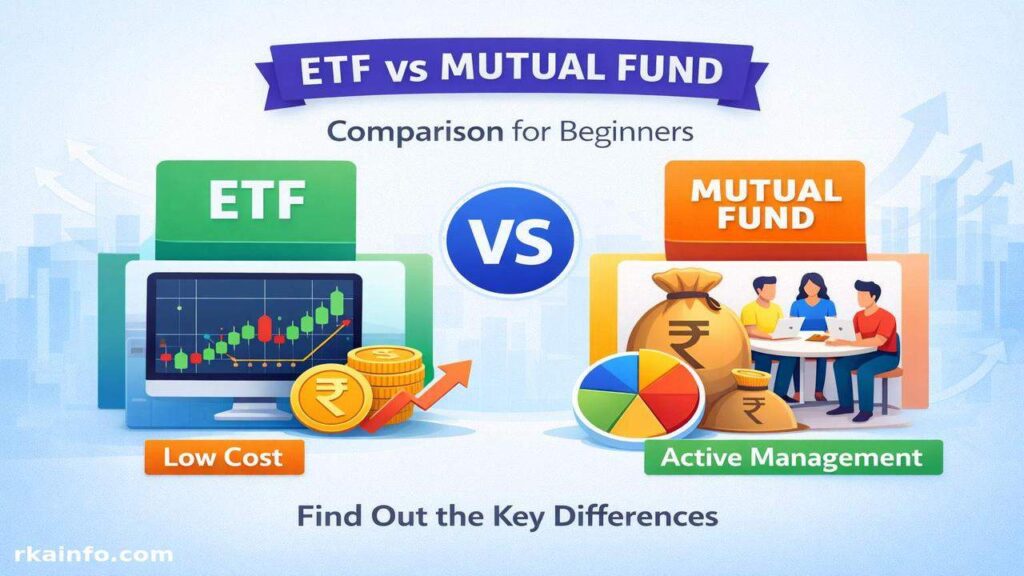
Let’s look at the ETF vs Mutual Fund comparison to understand the key differences clearly.
| Feature | ETF (Exchange Traded Fund) | Mutual Fund |
|---|---|---|
| How You Buy | Buy and sell on the stock market through a Demat account | Buy directly through fund houses or investment apps |
| Price Movement | Price changes every minute during market hours | Price changes only once a day (end of market) |
| Expense Ratio (Fees) | Very low | Higher (because of fund manager fees) |
| Who Manages It | Mostly passive (tracks an index) | Actively or passively managed by a fund manager |
| Minimum Investment | 1 unit (can start with ₹50–₹100) | Usually ₹500 or more |
| Liquidity | Can sell instantly during market hours | Can redeem anytime, but money credited in 1–2 days |
| Transparency | You can see holdings daily | Portfolio updated monthly |
| Best For | DIY investors who like control and low cost | Beginners who want simplicity and expert management |
So, mutual funds vs etf which is better ?
Here’s my honest take after trying both:
- Choose ETFs if you already have a Demat account, want lower costs, and prefer managing investments yourself.
- Choose Mutual Funds if you’re a beginner, want SIP options, and don’t want to track prices daily.
Personally, I use both. My SIPs run in mutual funds, and I buy ETFs whenever I have extra cash. That way, I get the best of both worlds — the discipline of mutual funds and the cost advantage of ETFs.
Final Tip:
When choosing between ETF vs Mutual Fund, don’t overthink it.
Start with what feels simpler to you. You can always mix both later once you’re comfortable.
The goal isn’t to pick the “perfect” option — it’s to start early and stay consistent. That’s how real wealth grows.
How to Invest in ETF (Step-by-Step)
If you’re learning ETF vs Mutual Fund, starting ETFs is simple:
Open a Demat Account
If you don’t already have one, open with brokers like Zerodha, Groww, or Angel One.
Transfer Money to Your Trading Account
Add funds for your first investment.
Choose the Right ETF
For beginners, start with a simple index ETF — like Nifty 50 or Sensex ETF.
Check Volume and Expense Ratio
Higher trading volume = easier to buy/sell. Lower expense ratio = better long-term returns.
Buy During Market Hours
Place your order between 9:15 AM and 3:30 PM — just like any stock.
Hold for the Long Term. ETFs perform best when held for 3–5 years or more.
Track Periodically, Not Daily. Don’t panic about daily ups and downs. Review once every few months.
Common ETF Mistakes Beginners Make
When people don’t understand ETF vs Mutual Fund, they often treat ETFs like trading stocks.
Treating ETFs Like Stocks
I bought and sold ETFs every week thinking I could “time the market.” That never worked. ETFs are meant for long-term investing, not trading.
Ignoring Expense Ratio
Some people buy random ETFs without checking fees. Even small differences (0.1% vs 0.5%) can make a big impact in the long run.
Buying When the Market Is High
I once bought a Nifty ETF when the Sensex was at an all-time high. Within a month, it fell 8%. The lesson: invest regularly, not all at once.
Not Understanding What ETF They’re Buying
There are ETFs for gold, banks, Nifty, Sensex, and even foreign markets. If you don’t know what’s inside, you might be taking unexpected risks.
Ignoring Liquidity
Some ETFs have very low trading volume. I learned the hard way when I tried selling one — and no one was buying. Always check daily volume before investing.
My Real Experience
In 2020, I started my first ETF investment with ₹2,000 in a Nifty 50 ETF. At that time, I had already been investing in mutual funds for two years.
At first, the ETF price didn’t move much. I almost thought of selling. But I decided to stay invested. By 2024, that same investment was worth around ₹3,400 — not bad for something I barely touched.
Later, I switched half my SIPs into ETFs because the costs were lower and returns were almost the same.
Now in 2026, I hold ETFs for Nifty 50, Bank Nifty, and even a small portion in a U.S. market ETF. My total ETF portfolio is around ₹1.8 lakh — and I’m planning to keep adding slowly.
The best part? I don’t feel stressed. I check once a month and then forget about it. That’s real peace.
Limitations & Disclaimer
This content is only for educational and informational purposes. It should not be considered financial or investment advice. I am not a SEBI-registered financial advisor.
ETFs and Mutual Funds both have advantages and risks. Their returns can change based on market conditions. Past performance does not guarantee future results.
Before investing, you should check your financial goals, risk tolerance, and investment time horizon. It is always better to do your own research or consult a qualified financial advisor before making any investment decision.
Frequently Asked Questions
1. Are ETFs better than mutual funds ?
Not always. ETFs are cheaper but need a Demat account. Mutual funds are easier for absolute beginners.
2. What is the minimum amount to invest in ETF vs Mutual Fund ?
In ETFs, you can start with as little as one unit — sometimes ₹50–₹100. In Mutual Funds, the minimum is usually ₹500 if you’re starting a SIP or ₹1000 for a one-time investment.
3. Do ETFs give dividends ?
Some do. Check if your ETF is “dividend” or “growth” type before buying.
4. Is ETF safe ?
As safe as the index or companies it tracks. There’s always market risk, but no fund manager bias.
5. Can I sell ETFs anytime ?
Yes, during market hours. Just like shares.
6. Which is better for long-term — ETF vs mutual fund ?
Both can build wealth. Choose ETFs for lower cost, mutual funds for convenience.
Conclusion
After using both for a few years, I’ve realized there’s no clear winner in the ETF vs Mutual Fund debate. Both have their strengths — it’s about what suits you and your comfort level.
If you want simplicity, automatic SIPs, and expert fund management, Mutual Funds are a great place to start. You don’t need a Demat account, and everything runs smoothly in the background.
But if you prefer lower costs, more transparency, and direct control through your Demat account, ETFs make perfect sense — especially in 2026, when more Indian investors are choosing index-based investing.
Personally, I use both. My SIPs run in mutual funds for consistency, while I buy ETFs whenever I have extra cash or when the market dips. This mix gives me balance, growth, and peace of mind.
So, instead of asking “ETF vs Mutual Fund — which is better ?”, ask yourself “Which one matches my habits and goals ?” Because the best investment is not what others choose — it’s what you can stick with for years.
Start small, stay patient, and remember — long-term discipline always beats short-term decisions.
For more details about ETFs, you can check authoritative sources like NSE India – ETF Information