By Rupesh Kumar
Published: February 06, 2026
Last Updated: March 12, 2026
Introduction
Many people think saving money and investing money are the same thing. I also believed this when I started managing my own money. I used to keep all my extra money in my savings account and felt proud that I was saving regularly.
But after a few years, I noticed something important. My money was safe, but it was not growing much. Inflation was slowly reducing its real value. That is when I started learning about the difference between savings and investment.

Understanding this difference can completely change how you manage your money. In this guide, I will explain everything in a simple and practical way, with examples from everyday Indian life.
What is Saving ?
Saving means keeping money aside for future use without taking risk.
The main goal of saving is safety and easy access to money. Most people start their financial journey with saving because it feels comfortable and secure.
When I got my first income, I did exactly the same thing. I kept money in my bank account and thought that was the smartest financial decision.
Common saving options include:
| Saving Option | Risk Level | Returns | Liquidity |
|---|---|---|---|
| Savings Account | Very Low | 2–4% | Very High |
| Fixed Deposit (FD) | Low | 6–8% | Medium |
| Cash Savings | No Risk | 0% | High |
Savings are useful for:
- Emergency funds
- Short-term expenses
- Medical situations
- Daily financial security
However, saving alone cannot build long-term wealth. That is where the difference between savings and investment becomes important.
What is Investment ?
Investment means putting money into assets that can grow over time.
Unlike savings, investments involve some level of risk. But they also offer higher potential returns.

The main goal of investing is wealth creation.
Common investment options include:
| Investment Option | Risk Level | Average Returns | Time Horizon |
|---|---|---|---|
| Mutual Funds | Medium | 12–16% | Long term |
| Stocks | High | 14–20% | Long term |
| Real Estate | Medium | 8–12% | Long term |
| Gold | Medium | 7–10% | Long term |
I still remember my first SIP investment. I started with a small amount because I was nervous about market ups and downs.
But after some time, I noticed something interesting. Even with small investments, my money started growing slowly.
That is when the difference between saving and investing became very clear to me.
Difference Between Savings and Investment
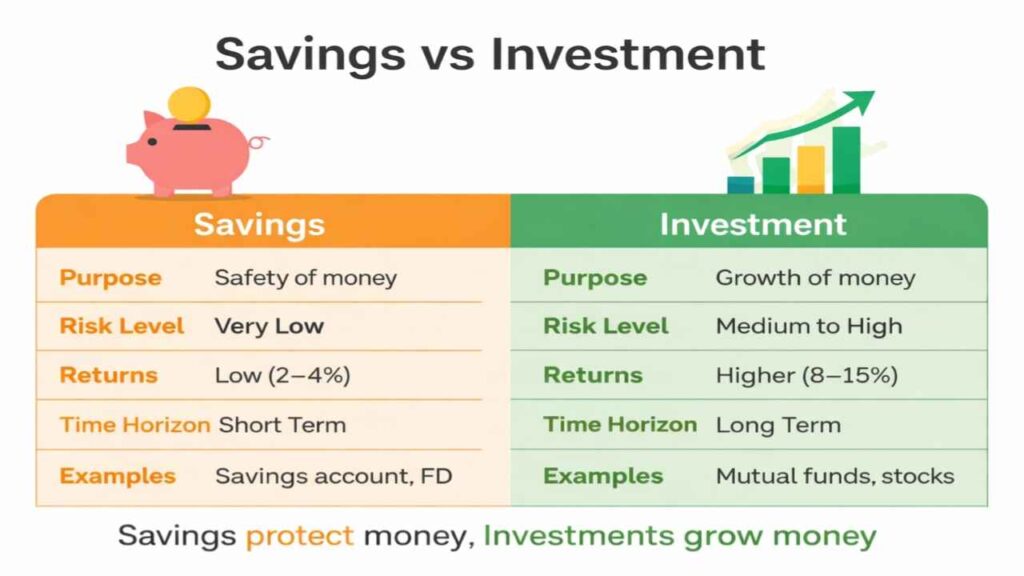
Many beginners get confused about saving vs investing money. Both are important, but they serve different purposes.
Understanding the difference between savings and investment helps you plan your finances better.
Here is a simple comparison:
| Feature | Savings | Investment |
|---|---|---|
| Purpose | Safety of money | Growth of money |
| Risk | Very low | Medium to high |
| Returns | Low | Higher potential |
| Time Period | Short-term (0 to 3 years) | Long-term (5+ years) |
| Liquidity | Easy access | Sometimes restricted |
| Example | Savings account, FD | Stocks, ETFs, mutual funds |
In simple words:
- Savings protect money
- Investments grow money
This simple idea explains the real saving and investment difference.
Why Only Saving Money Is Not Enough
In the beginning, I believed that saving regularly was enough to secure my future.
Every month I kept some money aside. Seeing my bank balance slowly increase felt satisfying.
But after a few years, I realised something important. Even though I was saving, my purchasing power was decreasing because of inflation.
This experience helped me truly understand the difference between savings and investment.
Problems with only saving money:
- Very low returns
- Inflation reduces real value
- Difficult to achieve big financial goals
- Limited wealth growth
This is why saving vs investing money is an important discussion in personal finance.
From my experience, a balanced approach works best.
When Should You Save Money ?
Saving money is best for short-term financial needs.
Situations where saving is helpful:
- Emergency expenses
- Medical costs
- Travel planning
- Short-term purchases
Financial experts usually recommend keeping 3–6 months of expenses in savings.
For example:
If your monthly expenses are ₹20,000
Your emergency fund should be around:
₹60,000 – ₹1,20,000
Savings create financial security before you start investing.
When Should You Start Investing ?
Investing becomes important when you start planning for long-term financial goals.
You should start investing when:
- Your income becomes stable
- You have emergency savings
- You are planning long-term goals
Common long-term goals include:
- Buying a house
- Children’s education
- Retirement planning
- Wealth creation
- Financial independence
Understanding the difference between saving and investing helped me start investing confidently.
Even small investments can grow over time.
The Power of Compounding
One of the biggest advantages of investing is compounding.
Compounding means earning returns on both the original investment and the accumulated returns.
Example:
If you invest ₹5,000 monthly with 12% average return:
| Time | Total Investment | Approx Value |
|---|---|---|
| 10 Years | ₹6,00,000 | ₹11,50,000 |
| 20 Years | ₹12,00,000 | ₹50,00,000 |
| 30 Years | ₹18,00,000 | ₹1.7 Crore |
This clearly shows why understanding the difference between savings and investment is important for long-term wealth building.
Savings alone usually cannot create this level of growth.
Saving vs Investing: Which One is Better ?
Many people ask me which option is better when it comes to saving vs investing money.
The truth is that both are necessary.
Savings provide financial safety.
Investments help money grow.
Key points:
- Saving is best for emergencies
- Investing builds long-term wealth
- Savings give stability
- Investments provide growth
So instead of choosing one, it is better to balance both.
Savings vs Investment for Different Age Groups
Over time, I noticed that financial planning changes with age. When I started earning in my twenties, I focused more on saving money because it felt safe. Later I realised that starting investments early is very helpful because money gets more time to grow.
As responsibilities increase in the thirties and forties, people usually balance savings and investments. After the age of fifty, many prefer safer options to protect their money.
| Age Group | Financial Focus |
|---|---|
| 20–30 | Start investing and build emergency savings |
| 30–40 | Balance savings and investments |
| 40–50 | Focus on stability and long-term goals |
| 50+ | Prefer safer options and protect wealth |
From what I have learned through experience, saving provides security while investing helps build future wealth. Balancing both at different stages of life is the smart approach.
Simple Strategy to Balance Savings and Investments
A simple financial plan could look like this:
| Income Allocation | Percentage |
|---|---|
| Daily Expenses | 50% |
| Lifestyle Spending | 30% |
| Savings and Investments | 20% |
From the 20%, you can divide money into:
- Emergency savings
- Long-term investments
This approach helps balance the difference between savings and investment in a practical way.
Practical Example from Daily Life
Let’s take a simple example.
Two people start earning at age 25.
Person A (Only Saves Money)
He saves ₹5,000 every month in a bank account.
After 20 years → around ₹18 lakh
Person B (Invests Money)
He invests ₹5,000 every month in mutual funds.
After 20 years → around ₹50 lakh
This difference happens because of investing and compounding.
This example helped me understand why investing is important for long-term financial growth.
Common Mistakes People Make
While learning about saving vs investing money, I noticed several mistakes people make.
1. Thinking Saving is Enough: Many people keep large amounts in savings accounts without investing.
2. No Emergency Fund: Investing without savings can create problems during emergencies.
3. Expecting Quick Returns From Investment: Investment is not a shortcut to become rich. I learned this after expecting fast growth in the beginning.
4. Ignoring Long-Term Planning: Some people only focus on monthly expenses and ignore retirement planning. This creates stress later in life.
5. Following the Crowd: Investing decisions should match your goals, not someone else’s advice.
Limitations & Disclaimer
This article is for educational purposes only. I am sharing personal experiences to explain financial concepts.
I am not a SEBI-registered financial advisor. Investing involves market risks, so always do your own research or consult a professional before making financial decisions.
Frequently Asked Questions
Q1. What is the difference between savings and investment?
Savings focus on safety and short-term needs, while investments aim for long-term money growth.
2. Why are savings important before investing?
Savings provide emergency funds so you don’t need to sell investments during difficult situations.
3. Can I save and invest at the same time?
Yes. A balanced approach of saving and investing works best for financial stability.
4. Which is safer — savings or investment?
Savings are safer because risk is very low and money is easily accessible.
5. Do investments always give higher returns than savings?
Not always in the short term, but investments generally grow more over a long period.
Conclusion
Understanding the difference between savings and investment is one of the most important steps in managing money.
I learned this slowly through personal experience. At first, I only focused on saving money. Later I realised that investing is equally important for financial growth.
Savings give security.
Investments build the future.
You don’t need a huge income to start. Even small steps like saving regularly and investing consistently can create big results over time.
Start simple. Stay patient. Keep learning.
Money management is not about being perfect.
It is about being prepared.
If you want to explore more about the difference between savings and investment, you can also read this detailed explanation by YES Bank. It explains how savings usually focus on safety and short-term needs, while investments aim for long-term financial growth.
You can also read this
Complete Share Market Guide for Beginners 2026